Cope Elimination Reaction: Mechanism, Stereochemistry & Applications
- Cope elimination is a concerted, intramolecular syn-elimination of an amine oxide.
- The reaction proceeds through a five-membered cyclic transition state.
- The amine oxide oxygen acts as the internal base and forms hydroxylamine.
- Heating commonly favors the less substituted Hofmann alkene.
- The Meisenheimer rearrangement can compete when allylic hydrogens are present.
1. What Is the Cope Elimination Reaction?
Basic Definition
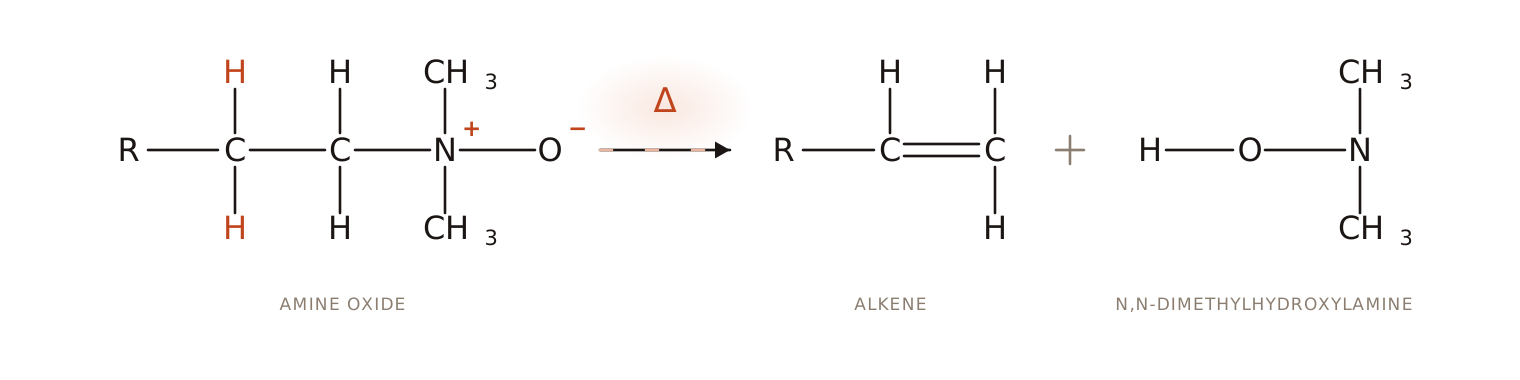
The Cope Elimination Reaction is an organic chemical reaction in which an amine oxide (a nitrogen-containing compound with an oxygen atom bonded to nitrogen) undergoes intramolecular elimination upon heating to produce an alkene (a carbon-carbon double bond) and an N,N-dialkylhydroxylamine as products.
The Name
The reaction is named after the American organic chemist Arthur C. Cope (1909–1966), who, along with his student E.R. Trumbull, first reported this reaction in 1949. Arthur Cope was a professor at the Massachusetts Institute of Technology (MIT) and made numerous contributions to organic chemistry, including the famous Cope Rearrangement (a different reaction involving [3,3]-sigmatropic rearrangement of 1,5-dienes) and the Cope Elimination discussed here.
One-Line Summary
Cope Elimination = Heating an amine oxide to produce an alkene + hydroxylamine through a concerted, intramolecular, syn-elimination mechanism via a five-membered cyclic transition state.
2. The Overall Reaction
General Equation

Or, written more clearly with a specific example:
Step-by-Step Breakdown of the Reaction
The Cope Elimination occurs in two main stages:
Stage 1: Formation of the Amine Oxide (Preparation of the Substrate)
Before the Cope Elimination can occur, you need to prepare the starting material — the amine oxide. This is done in two simple steps:
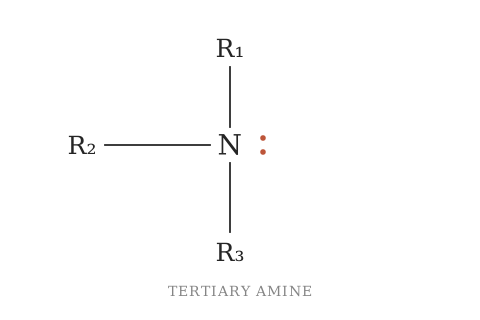
Step A: Start with a Tertiary Amine
A tertiary amine is a nitrogen atom bonded to three carbon groups (R₁, R₂, R₃) and has a lone pair of electrons on the nitrogen.
Step B: Oxidise the Tertiary Amine with Hydrogen Peroxide (H₂O₂)
When a tertiary amine is treated with Hydrogen Peroxide (H₂O₂) — a mild oxidising agent — the oxygen atom from H₂O₂ is added to the nitrogen's lone pair, forming an amine oxide (also called an N-oxide).
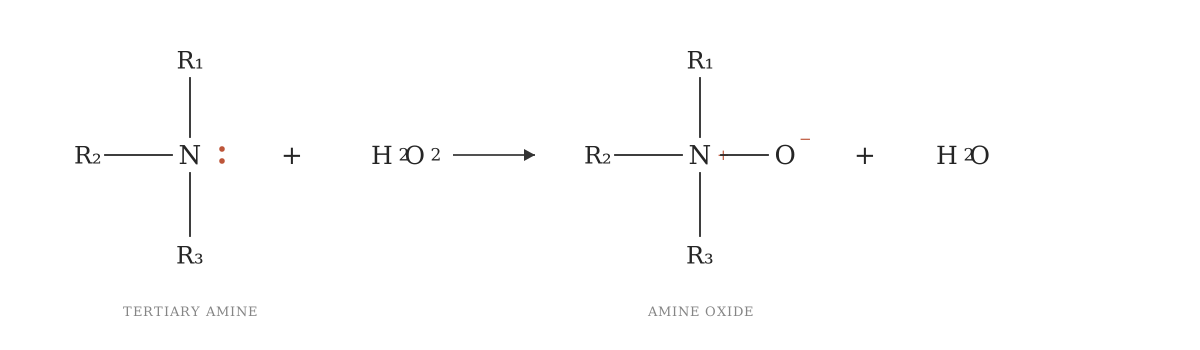
Alternatively, a peroxyacid (such as m-CPBA — meta-chloroperoxybenzoic acid) can be used as the oxidising agent.
Note: The amine oxide has a formal positive charge on nitrogen and a formal negative charge on oxygen. It is a zwitterion (a molecule with both positive and negative charges but overall neutral).
Stage 2: The Cope Elimination (Thermal Decomposition of the Amine Oxide)
Now comes the actual Cope Elimination. When the amine oxide is heated (typically at temperatures between 100°C and 200°C, depending on the substrate), it undergoes elimination to form an alkene and an N,N-dialkylhydroxylamine.

3. Mechanism of the Cope Elimination (Detailed)
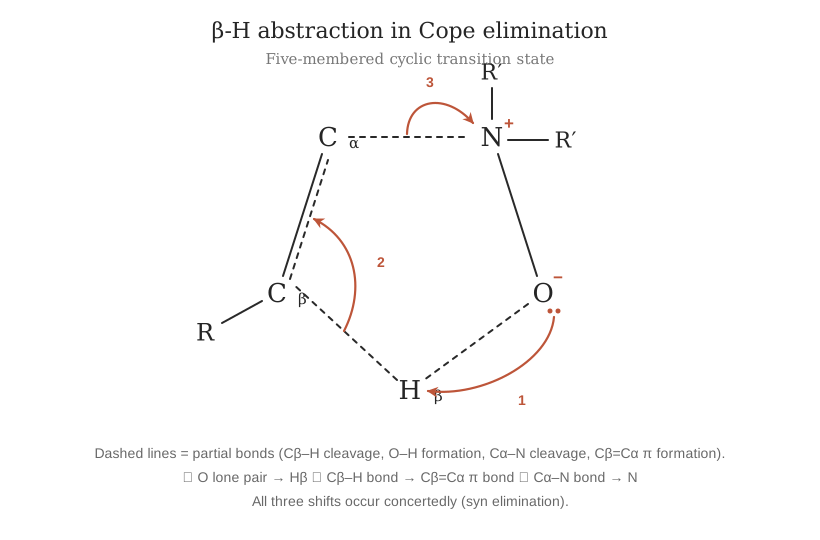
The Key Feature: A Five-Membered Cyclic Transition State
The Cope Elimination proceeds through a concerted mechanism — meaning all bond-breaking and bond-forming events happen simultaneously in a single step. There is no carbocation intermediate, no carbanion intermediate, and no free radical intermediate.
The mechanism involves a five-membered cyclic transition state in which:
Drawing the Transition State
Electron Flow (Curved Arrows)
In the transition state, the following events occur simultaneously:
Why Does It Go Through a Five-Membered Ring?
This is a crucial question. The answer lies in geometry and orbital alignment:
4. Stereochemistry: SYN-Elimination
What Is Syn-Elimination?
The Cope Elimination is a syn-elimination (also called cis-elimination). This means that the β-hydrogen and the leaving group (the nitrogen) must be on the same side (same face) of the C(α)–C(β) bond for the elimination to occur.
This is in contrast to the E2 elimination (the more common elimination reaction in organic chemistry), which proceeds through an anti-periplanar geometry — the β-hydrogen and the leaving group must be on opposite sides (anti to each other) of the C–C bond.
Why Syn-Elimination?
The syn-elimination geometry is dictated by the five-membered cyclic transition state. For the O⁻ to simultaneously abstract the β-hydrogen AND for the C–N bond to break, all five atoms (O, H, Cβ, Cα, N) must be in a cis (syn) arrangement — they must all be able to form the five-membered ring. This is only possible if the H and the N are on the same side of the C(α)–C(β) bond.
Anti-Elimination vs. Syn-Elimination — Comparison
| Feature | Anti-Elimination (E2) | Syn-Elimination (Cope) |
|---|---|---|
| Geometry required | β-H and leaving group are ANTI (opposite sides, 180° dihedral angle) | β-H and leaving group are SYN (same side, 0° dihedral angle) |
| Transition state | Open, extended (no cyclic TS) | Five-membered cyclic TS |
| Base | External base (e.g., NaOEt, KOH) | Internal base (the O⁻ of the amine oxide) |
| Reagent | Strong base + substrate | Heat alone (thermal reaction) |
| Example | Dehydrohalogenation of alkyl halides | Thermal decomposition of amine oxides |
Stereochemical Consequence: Zaitsev's Rule Does NOT Always Apply
In standard E2 eliminations, Zaitsev's rule predicts that the more substituted alkene (the more stable one) will be the major product. However, in the Cope Elimination, the syn-elimination requirement means that the stereochemistry of the substrate controls which β-hydrogen is removed, and therefore which alkene is formed.
In cyclic systems, this has profound consequences:
Example — Cyclohexylamine oxide:
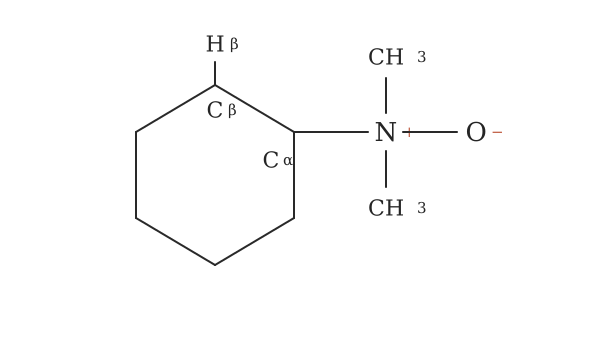
In a cyclohexane ring, the β-hydrogen and the nitrogen group must be cis (both axial, or both equatorial on the same face) for elimination to occur. If the only available β-hydrogens are on the opposite face (anti to the nitrogen), elimination will not happen at those positions.
This can lead to the formation of the less substituted alkene (the Hofmann product) rather than the more substituted one (the Zaitsev product), depending on the stereochemistry of the substrate.
5. Regiochemistry: Hofmann Product Preference
What Is Hofmann Elimination?
The Hofmann product is the less substituted alkene (the less stable, kinetically controlled product). The Zaitsev product is the more substituted alkene (the more stable, thermodynamically controlled product).
Why Does Cope Elimination Favour the Hofmann Product?
Several factors contribute to the tendency of Cope Elimination to give the less substituted (Hofmann) alkene as the major product:
Example:
Consider the amine oxide derived from 2-phenyl-2-(dimethylamino)butane:
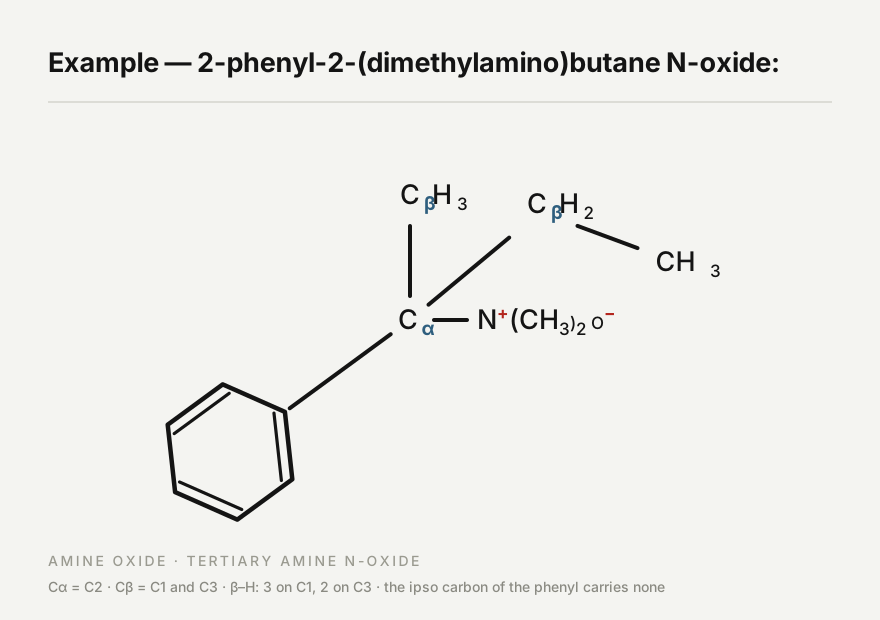
Upon heating, two possible alkenes can form:
| Product | Type | Stability | Major/Minor? |
|---|---|---|---|
| 2-Phenyl-2-butene (more substituted) | Zaitsev product | More stable | Minor (in many cases) |
| 2-Phenyl-1-butene (less substituted, terminal) | Hofmann product | Less stable | Major (in many cases) |
However, the exact product ratio depends on the specific substrate structure, and in some cases, the Zaitsev product can still predominate if the stereochemical requirements favour it.

6. The Complete Reaction Sequence (Starting from an Amine)
In practice, the Cope Elimination is rarely performed on an isolated amine oxide. Instead, the entire sequence is usually carried out in one pot (one reaction vessel):
Step 1: Start with a Tertiary Amine
        R₁
        |
   R₂ — N:
        |
        R₃
Step 2: Oxidise with H₂O₂ (or m-CPBA)
   R₃N  +  H₂O₂  →  R₃N⁺—O⁻  +  H₂O
   (Tertiary amine)   (Amine oxide)
Step 3: Heat the Amine Oxide (100°C–200°C)
   R₃N⁺—O⁻  →(Δ)→  Alkene  +  R'₂N—OH
   (Amine oxide)                  (Hydroxylamine)
Overall Transformation
Tertiary Amine →[H₂O₂]→ Amine Oxide →[Δ]→ Alkene + Hydroxylamine
The net effect is: Remove H and NR₂ from adjacent carbons and form a C=C double bond.
7. Detailed Example with a Specific Substrate
Example: 2-(Dimethylamino)butane
Let us walk through the Cope Elimination of a specific substrate:
Substrate: 2-(Dimethylamino)butane (a tertiary amine)
        CH₃ CH₂
           /
     H₃C—CH—N(CH₃)₂
Step 1: Oxidation with H₂O₂
        CH₃ CH₂
           /
     H₃C—CH—N⁺(CH₃)₂ O⁻

     (2-(Dimethylamino)butane N-oxide)
Step 2: Heat (Cope Elimination)
There are two types of β-hydrogens available:
Due to the syn-elimination mechanism and steric factors, the Cope Elimination typically favours the Hofmann product (1-butene) as the major product.
        CH₃ CH₂                       CH₂=CH-CH₂CH₃        HO-N(CH₃)₂
           /           Δ
     H₃C—CH—N⁺(CH₃)₂ O⁻  →    1-Butene   +   N,N-Dimethylhydroxylamine

                                    (Major: Hofmann)

                                    CH₃-CH=CH-CH₃

                                    2-Butene

                                    (Minor: Zaitsev)
8. Cope Elimination vs. Hofmann Elimination
Both the Cope Elimination and the Hofmann Elimination are elimination reactions that tend to give the less substituted (Hofmann) alkene. However, they are fundamentally different reactions:
| Feature | Cope Elimination | Hofmann Elimination |
|---|---|---|
| Substrate | Amine oxide (R₃N⁺–O⁻) | Quaternary ammonium salt (R₄N⁺X⁻) |
| Preparation | Oxidise tertiary amine with H₂O₂ | Methylate tertiary amine with excess CH₃I, then treat with Ag₂O |
| Base | Internal base (O⁻ of the amine oxide) | External base (OH⁻ from Ag₂O/NaOH) |
| Driving force | Heat (thermal decomposition) | Strong base (hydroxide ion) |
| Mechanism | Concerted, intramolecular, syn-elimination via 5-membered cyclic TS | E2 elimination (intermolecular, anti-periplanar) |
| Stereochemistry | SYN-elimination | ANTI-elimination |
| Typical temperature | 100°C–200°C | Room temperature to mild heating |
| By-product | N,N-Dialkylhydroxylamine (R₂N–OH) | Tertiary amine (R₃N) + H₂O |
| Product preference | Hofmann (less substituted) | Hofmann (less substituted) |
9. Advantages of the Cope Elimination
10. Limitations and Disadvantages
R₂N⁺(O⁻)-CH₂-CH=CH₂ → R₂N-O-CH₂-CH=CH₂ (Meisenheimer product)
This [2,3]-rearrangement competes with the Cope Elimination whenever an allylic C–H bond is present β to the nitrogen. In substrates without allylic hydrogens, the Cope Elimination is the dominant pathway.
11. The Meisenheimer Rearrangement (Important Competing Reaction)
What Is the Meisenheimer Rearrangement?
When an amine oxide has an allylic hydrogen (a hydrogen on a carbon adjacent to a C=C double bond) in the β-position, the amine oxide can undergo a [2,3]-sigmatropic rearrangement instead of the Cope Elimination. This is called the Meisenheimer rearrangement (named after Jakob Meisenheimer).
The Reaction
         O⁻
         |
    R₂N⁺—CH₂—CH=CH₂   →   R₂N—O—CH₂—CH=CH₂
    (Amine oxide)             (O-Allylhydroxylamine ether)
When Does It Compete?
How to Avoid It?
12. Applications in Organic Synthesis
(a) Synthesis of Alkenes
The Cope Elimination provides a useful method for synthesising less substituted (Hofmann) alkenes that may be difficult to prepare by other elimination methods.
(b) Synthesis of Strained or Unusual Alkenes
The Cope Elimination can be used to prepare alkenes in strained ring systems where other elimination methods would fail or give unwanted side reactions.
(c) Functional Group Transformations
The Cope Elimination can be part of a multi-step synthetic sequence. For example:
(d) Natural Product Synthesis
The Cope Elimination has been used in the total synthesis of several natural products where a specific alkene geometry or regiochemistry was required.
13. Summary of Key Points
| Feature | Details |
|---|---|
| Reaction Name | Cope Elimination |
| Named After | Arthur C. Cope (American organic chemist, MIT) |
| Year Reported | 1949 |
| Substrate | Amine oxide (R₃N⁺–O⁻) |
| Preparation of Substrate | Oxidise a tertiary amine with H₂O₂ or m-CPBA |
| Reagent/Condition | Heat (100°C–200°C) |
| Mechanism | Concerted, intramolecular, syn-elimination via a five-membered cyclic transition state |
| Transition State | Five-membered ring: O ··· H ··· C(β) ··· C(α) ··· N |
| Products | Alkene + N,N-Dialkylhydroxylamine (R₂N–OH) |
| Stereochemistry | SYN-elimination (cis-elimination) |
| Regiochemistry | Favors Hofmann product (less substituted alkene) |
| Key Advantage | Mild conditions, no external base, high selectivity |
| Key Limitation | Competing Meisenheimer rearrangement (if allylic H present) |
| Competing Reaction | [2,3]-Sigmatropic rearrangement (Meisenheimer) |
| Comparison | Different from Hofmann Elimination (which uses quaternary ammonium salts and external base, and proceeds via anti-elimination/E2) |
14. Memory Tricks and Exam Tips
The "5-Membered Ring" Rule
Always remember: Cope Elimination = Five-membered cyclic transition state = Syn-elimination. If the question asks about the geometry of the Cope Elimination, the answer is always syn (cis).
The "Heat Alone" Rule
Cope Elimination needs only heat — no base, no catalyst. If a reaction gives an alkene upon simply heating an amine oxide, it is a Cope Elimination.
The "O⁻ Does the Work" Rule
The oxygen anion (O⁻) of the amine oxide acts as the internal base that abstracts the β-hydrogen. It is both the leaving group (eventually becoming part of the hydroxylamine) and the base.
The "Hofmann Product" Rule
Cope Elimination tends to give the less substituted alkene (Hofmann product) due to steric and stereoelectronic factors. Remember: Cope = Hofmann product = syn-elimination = 5-membered TS = heat only.
Quick Comparison: Cope vs. Hofmann vs. E2
| Cope Elimination | Hofmann Elimination | E2 Elimination | |
|---|---|---|---|
| Substrate | Amine oxide | Quaternary ammonium salt | Alkyl halide |
| Base | Internal (O⁻) | External (OH⁻) | External (RO⁻, OH⁻) |
| Geometry | Syn | Anti | Anti |
| Product | Hofmann | Hofmann | Zaitsev (usually) |
| Condition | Heat | Strong base | Strong base |
| TS | 5-membered cyclic | Open (E2) | Open (E2) |
- Cope elimination is a concerted, intramolecular syn-elimination of an amine oxide.
- The reaction proceeds through a five-membered cyclic transition state.
- The amine oxide oxygen acts as the internal base and forms hydroxylamine.
- Heating commonly favors the less substituted Hofmann alkene.
- The Meisenheimer rearrangement can compete when allylic hydrogens are present.
About Cope Elimination Reaction: Mechanism, Stereochemistry & Applications
Cope Elimination Reaction: Mechanism, Stereochemistry & Applications is a fundamental concept in organic chemistry. Understanding the mechanisms, reaction conditions, and stereo-chemical outcomes is crucial for mastering organic chemistry. Our curated resources provide step-by-step visualizations to help you excel.
SUPPORT & DETAILS